
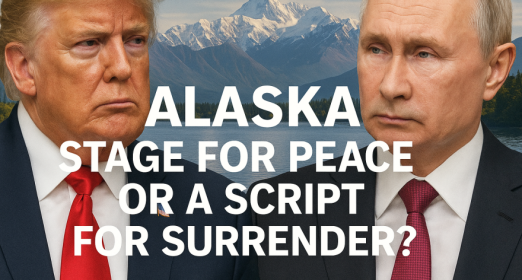
When Donald Trump and Vladimir Putin meet in Anchorage on August 15, 2025, Alaska will be more than just a backdrop – it will be a calculated stage with the weight of history. Once Russian territory, now a U.S. state, it’s a setting tailor-made for two leaders who understand the value of political theater. But it’s what will not be said – and who will not be in the room – that makes this meeting so dangerous.

A “Listening Exercise” – but for Whose Benefit?
The White House is framing the summit as a “listening exercise,” a chance for Trump to “get a better understanding” of Putin’s position. As Press Secretary Karoline Leavitt put it:
“Only one party that’s involved in this war is going to be present, and so this is for the president to… get… a more firm and better understanding of how we can hopefully bring this war to an end.”
But let’s not mistake polite phrasing for real progress. Studies show that only about 16% of wars since World War II have ended in durable peace agreements – and a third of those collapsed soon after signing. The risk is that this summit becomes a photo opportunity that changes nothing on the ground.
Ukraine – Still on the Sidelines
Ukrainian President Volodymyr Zelenskyy will not be at the table. This is not a scheduling oversight – it’s a deliberate decision, and it’s already a diplomatic victory for Moscow. When a nation is excluded from talks about its own future, it sends a chilling signal about who gets to define peace.
European leaders and Zelenskyy himself have warned that excluding Ukraine risks legitimizing territorial losses without the country’s consent. As one European analysis bluntly put it:
“It may be a signal for a restart of relations… This is no longer just diplomacy. It is a redrawing of the geopolitical map.”
The Symbolism of Alaska – More Than Cold Air
Alaska is not just a remote, scenic state. It’s a symbol: a meeting place between superpowers on “neutral” ground, but with deep historical undertones. Geographically close to Russia and once part of its empire, the choice of venue is a nod to history – and, perhaps, to Moscow’s own sense of narrative.
But proximity does not equal parity. Putin’s known demands are far from neutral: Ukraine must abandon NATO ambitions, demilitarize key regions, and cede occupied territories in exchange for a ceasefire.
Expert Warnings – The Numbers Don’t Lie
Analysts at the Center for Strategic and International Studies (CSIS) underline the harsh reality: lasting peace requires Ukraine’s participation, long-term security guarantees, and a multilateral framework involving both the EU and the U.S. Without these, the probability of a truly sustainable agreement is close to zero.
As Seth G. Jones of CSIS put it:
“Only 16% of wars end with a peace agreement – the rest end either in military victory or in settlements that collapse.”
Possible Outcomes – And What They Mean
| Scenario | Likelihood | Implication |
| Sustainable peace deal | Near zero | Impossible without Ukraine and multilateral guarantees |
| Temporary ceasefire / frozen front | Medium | Can be sold as progress, but likely unstable |
| Russian diplomatic win | Possible | Legitimizes territorial expansion without real concessions |
| Follow-up talks with Ukraine involved | Possible | Depends entirely on EU/U.S. diplomatic pressure |
The Stakes in Alaska
The Alaska meeting is less about signing a treaty and more about taking the temperature of diplomacy. Trump could walk away claiming he “delivered,” while in reality legitimizing Russian expansion.
Without clarity from the EU, binding security arrangements, and Ukraine at the table, any agreement risks being nothing more than a formalized surrender dressed up as peace.
Alaska should not become the place where the world silently rewrites the rules of sovereignty. In an era when territorial integrity and the international legal order are under assault, the right response is not applause – it is vigilance.